Designing a Kosher Kitchen the Right Way
Planning a kosher kitchen is unlike any other kitchen project. The laws of kashrut (Jewish dietary laws) require a level of separation between meat (fleishig) and dairy (milchig) that shapes every decision — from how many sinks you install to where you place each set of cabinets. Symco Kitchens has designed and supplied cabinetry for dozens of kosher kitchens across Lakewood, Howell, Freehold, and throughout Central NJ. Here's everything you need to know.
The Core Principle: Complete Separation
A halachically compliant kosher kitchen maintains complete separation between meat and dairy. That means:
- Separate cooking appliances (ovens, cooktops, or ranges)
- Separate sinks — minimum one per side, often a third "pareve" sink
- Separate dishwashers — one for meat dishes, one for dairy
- Separate storage zones — dedicated cabinets for meat dishes, dairy dishes, and pareve items
- Separate prep areas — ideally, physically divided countertop sections
Sink Configuration: The 3-Sink Setup
One of the most common questions we get: how many sinks do I need in a kosher kitchen?
The Standard Setup: 2 Sinks
The minimum functional setup includes one sink on the meat side and one on the dairy side. These should be clearly marked and physically separated as much as possible.The Preferred Setup: 3 Sinks
Most families prefer three sinks:
- Meat sink — dedicated to washing meat dishes, pots, and utensils
- Dairy sink — dedicated to dairy dishes and utensils
- Pareve sink — for produce, vegetables, fruits, and non-meat/dairy items
Cabinet Planning for Triple Sinks
When designing the cabinet layout:
- Each sink gets its own base cabinet (typically 30"–36" wide)
- Allow for undercabinet plumbing routing — your plumber needs access
- Leave space between meat and dairy sides — an island, a wall, or at minimum a clear visual divider
- Label cabinets clearly; color coding (blue for dairy, red for meat) is common
Double Oven Setup
Most kosher kitchens require two separate ovens — one for meat and one for dairy.
Built-In Wall Oven Pairs
The most elegant solution is a pair of tall oven towers flanking a section of base cabinets or a refrigerator column. Each tower holds one or two ovens.
Cabinet Configuration:
- (2) 30"–33" tall oven towers
- Each tower holds a single or double oven
- Upper cabinets above the towers for dish storage specific to that side
Range Approach
Some kitchens use one dedicated range per side:
- Meat range (often a 36" or 48" commercial-style range) on one wall
- Dairy range on a separate wall or the opposite run
- Each range needs its own dedicated hood ventilation
Warming Drawers & Microwave Drawers
For Shabbos compliance, warming drawers are very popular in Lakewood-area kosher kitchens. These can be built into the cabinet run on each side. Similarly, two microwave drawers (one meat, one dairy) can be integrated into the cabinet design with no counter intrusion.
Dual Dishwasher Planning
Two dishwashers are standard in a properly outfitted kosher kitchen. Options include:
Side-by-Side Under Counter
Place one dishwasher on the meat side of the sink and one on the dairy side. This is the most intuitive layout — each dishwasher is right next to its matching sink.Drawer Dishwashers
Fisher & Paykel and similar brands offer drawer-style dishwashers that fit into a standard 24" base cabinet opening. These are popular for smaller kitchens or for adding a second dishwasher where space is tight.Cabinet Considerations for Dishwashers
- Standard dishwasher opening: 24" wide base cabinet (no shelf)
- Panel-ready dishwashers can be fitted with cabinet fronts to match your door style
- Leave adequate space for door swing — don't plan cabinets that block the open door
Storage: Separate Cabinets for Every Category
A well-designed kosher kitchen has clearly designated storage for:
Meat Side Cabinets
- Base cabinets: Pots, pans, roasting pans, meat utensils
- Upper cabinets: Meat dishes, serving bowls, meat-specific small appliances
- Pantry: Non-dairy packaged foods, meat-approved condiments
Dairy Side Cabinets
- Base cabinets: Dairy pots and pans, dairy baking supplies
- Upper cabinets: Dairy dishes, cups, dairy small appliances
- Pantry: Dairy products (butter, cheeses), dairy-approved packaged items
Pareve Storage
- Dedicated cabinet(s) for pareve dishes, pots, and utensils
- Often located near the pareve sink or in a pantry tower
- Pareve small appliances (blenders, food processors) need their own space
Pesach Storage
Many families also require locked or dedicated storage for Pesach dishes and appliances — typically a separate pantry cabinet or a room in the basement. Some families include a Pesach closet as part of the kitchen design, often a tall pantry with a lock.Layout Strategies
Two-Zone Linear Kitchen
For galley or single-wall kitchens, place the meat zone at one end and the dairy zone at the other, with pareve prep and a pareve sink in the center. This is common in apartments and townhomes.L-Shape with Separation
Place meat on one leg of the L and dairy on the other. The corner can serve as a natural divider, often occupied by a lazy Susan or blind corner unit.Island-Divided Kitchen
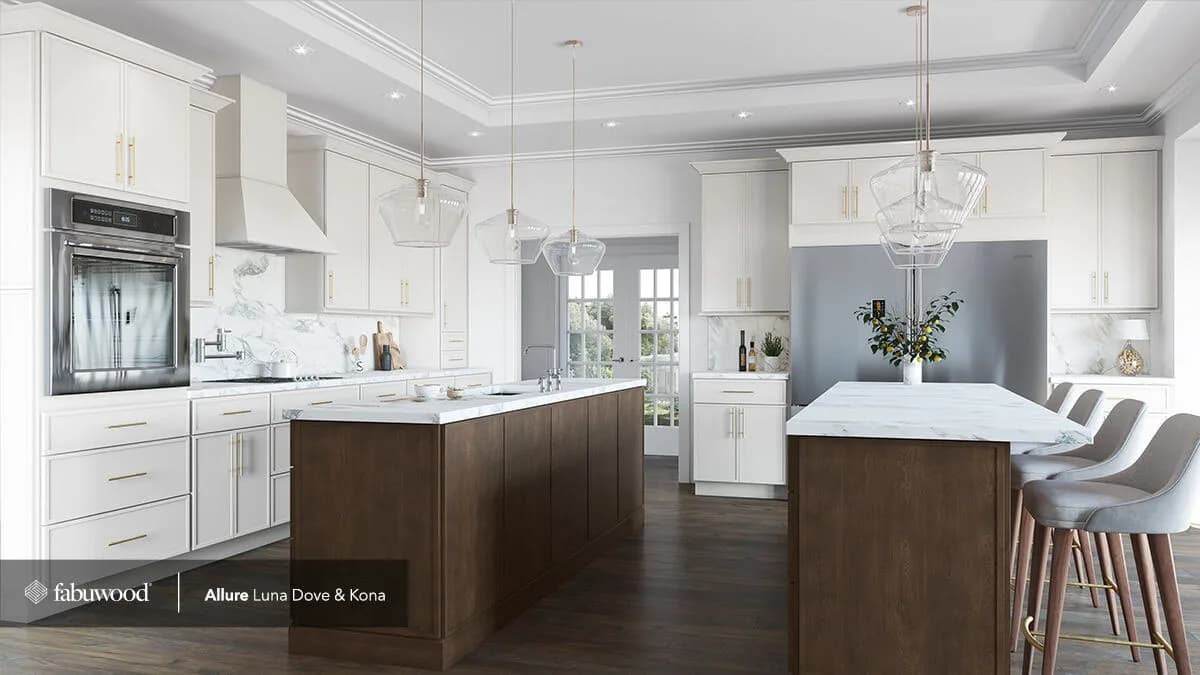
An island running down the center acts as a natural divider between meat and dairy runs along opposite walls. The island itself is typically pareve and holds the pareve sink.Two Separate Kitchens
For large homes, the ideal solution: a full meat kitchen and a full dairy kitchen. This is becoming increasingly popular in Lakewood, Howell, and Jackson. Both kitchens have complete sets of cabinets, appliances, and sinks. One kitchen handles Shabbos prep, the other handles weekday dairy cooking.Recommended Cabinet Lines for Kosher Kitchens
Since kosher kitchens often involve higher cabinet counts (more storage zones, pantry towers, etc.), cost-per-cabinet matters.
Best value for large kosher kitchens:
- Fabuwood — affordable, plywood boxes, lifetime warranty; ideal for completing both meat and dairy sides on budget
- CNC Cabinetry — 100+ door styles, competitive pricing; great for larger kitchens
- JSI Cabinetry — solid construction, clean lines, works well in transitional and traditional kosher kitchens
- Kitchen Craft (Semi-Custom) — extensive finish options, custom sizing
- Brighton Cabinetry (Full Custom) — built to 1/16", unlimited finishes, perfect for unique layouts
Color Coding Your Kosher Kitchen
Many families use a visual color system for plates, pots, and utensils. This is worth planning around when choosing cabinet colors:
- Blue = dairy (milchig)
- Red = meat (fleishig)
- Green or neutral = pareve
Common Mistakes to Avoid
1. Not planning enough storage. Kosher kitchens need roughly double the storage of a standard kitchen — you're buying duplicates of almost every item.
2. Forgetting pareve prep space. Plan a dedicated counter zone and sink for pareve prep. It gets used constantly.
3. Undersizing the pantry. Kosher families often buy in bulk for Shabbos and Yom Tov. Include at least one or two tall pantry towers.
4. Not accounting for Pesach. Plan where your Pesach kitchen setup will go — either a dedicated room or a large pantry area.
5. Single oven "for now." Build the second oven into the plan from the start. Retrofitting a second oven tower later is expensive.
Ready to Plan Your Kosher Kitchen?
Symco Kitchens is located in Howell, NJ — minutes from Lakewood — and has extensive experience designing kosher kitchens for families throughout Ocean County, Monmouth County, and all of Central NJ. We understand the halachic requirements and can help you plan the layout, cabinet counts, and storage zones from the ground up.
Get a free estimate or visit our showroom at 6479 Hwy Rt 9, Howell, NJ 07731. We serve Lakewood, Toms River, Jackson, Freehold, and all of Central NJ.
Frequently Asked Questions
How many sinks does a kosher kitchen need?
A halachically compliant kosher kitchen needs a minimum of two sinks — one dedicated to meat (fleishig) and one to dairy (milchig). Most families prefer three sinks: meat, dairy, and a pareve sink for washing produce and vegetables. The pareve sink is typically placed in the center of the kitchen near the main prep area.
Can you have two dishwashers in a kosher kitchen?
Yes — two dishwashers are standard in a properly outfitted kosher kitchen: one for meat dishes and one for dairy dishes. They are typically placed adjacent to their respective sinks. Drawer-style dishwashers are a popular option for smaller kitchens or tight spaces.
How do you physically separate meat and dairy in a kitchen layout?
Common strategies include placing meat and dairy zones on opposite walls with an island or clear divider in between; using an L-shaped layout with each leg dedicated to one side; or building a completely separate second kitchen. Each zone should have its own dedicated cabinets, sink, and appliances — clearly labeled or color-coded (blue for dairy, red for meat is common).
Do I need two ovens in a kosher kitchen?
Yes — a kosher kitchen requires two separate ovens: one for meat and one for dairy. The most common approach is a pair of tall oven towers (built-in wall oven cabinets), one on each side. Some families use two separate ranges instead. Warming drawers and microwave drawers can also be integrated into each side.
Ready to Start Your Kitchen Project?
Get a free estimate and expert design help from our team.